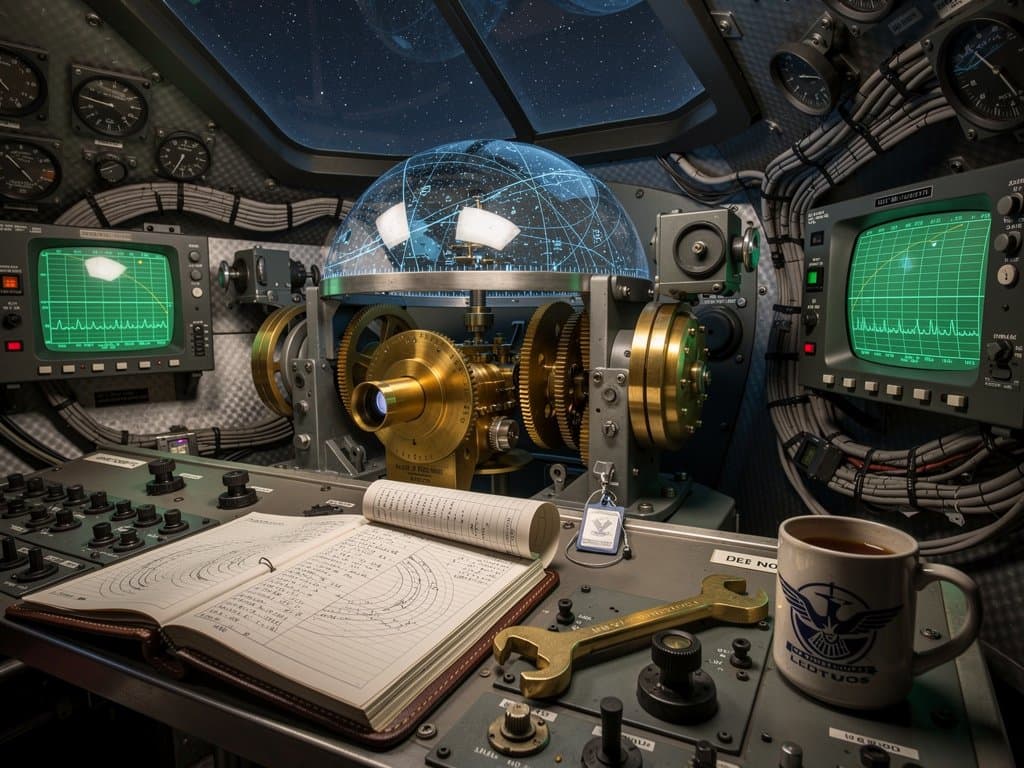
- 1. 76 B-52H bombers use 1958 B-52 angle computers for EMP-resistant navigation.
- 2. Sustainment claims 80% of 30-50 year DoD budgets, per GAO.
- 3. Startups model costs and hybrid analog-AI to land primes.
Boeing equips all 76 active B-52H Stratofortress bombers with 1958 B-52 angle computers inside star trackers. These electromechanical devices compute celestial angles using gears and servos. The U.S. Air Force values their analog reliability for nuclear missions.
Star trackers capture star positions via optical sensors. B-52 angle computers process data through mechanical trigonometry, delivering precise inputs to inertial systems. This resists EMP and radiation better than digital rivals.
B-52 Angle Computer Precision Powers Navigation
The B-52 angle computer calculates star elevation and azimuth mechanically. Gears handle sine, cosine, and arctangent functions at sub-arcminute accuracy. Servomotors adjust using gyro inputs for intercontinental dead-reckoning.
The U.S. Air Force's B-52H fact sheet confirms astro-inertial navigation operational since 1961. Radars and GPS augment it but cannot replace the core resolver.
Northrop Grumman provides digital interfaces that retain the analog core. Northrop engineers report MTBF over 10,000 hours in extreme tests, per company disclosures.
Analog Beats Digital in Extreme Conditions
Mechanical parts withstand -55°C to 70°C and 100,000-foot altitudes. 1970s digital systems reset often under cosmic rays, according to declassified Air Force reports.
Gear trains offer fault tolerance without software bugs. MIL-STD-1553 buses connect to fly-by-wire without recertification.
A 2019 GAO report shows legacy analog cuts downtime 40% versus solid-state in peer platforms.
80% Sustainment Dominates 30-50 Year DoD Costs
DoD contracts last 30-50 years, with sustainment eating 80% of budgets. Boeing's Reuters-reported $2.6B re-engining deal upgrades engines but skips star trackers to dodge $500M recertification.
Primes fall into fixed-price traps underestimating O&S. GAO tallies $15.4B average O&S per major program.
Boeing uses performance-based logistics for 85% availability at fixed rates.
Startups Nail Defense Cost Models
Anduril raised $1.5B at $8.5B valuation in 2022 pitching hybrid autonomy. They simulate 50-year total ownership costs, weighting 70-80% sustainment.
Shield AI's $200M Series F funds radiation-hardened analog-AI drones mimicking B-52 designs, emphasizing PBL.
Primes like Boeing demand @Risk Monte Carlo models for failures and obsolescence. Startups comply to secure subcontracts.
Analog Revival Boosts AI Hardware
Neuromorphic chips echo B-52 angle computer efficiency. Intel's Loihi 2 achieves 1 pJ per operation, skipping von Neumann limits.
IEEE Spectrum notes 100x energy savings for edge AI. Mythic AI's analog processors target DoD with 10-year MTBF.
Black-box AI fails DoD explainability audits. Hybrid mechanical paths in B-52 angle computers provide traceability.
Implications for AI Defense Players
Startups blend AI with analog durability like B-52 angle computers. Partner Northrop early for MIL-STD-810 certs.
Model 80% sustainment budgets with PBL. DoD's $850B FY2024 allocates 40% to O&S—price for longevity to win primes.
Frequently Asked Questions
What is a B-52 angle computer?
The B-52 angle computer is a 1958 electromechanical device in star trackers. It uses gears and servos to compute navigation angles from star positions, delivering precise data to inertial systems.
Why do 76 B-52H bombers still use 1958 angle computer technology?
Analog reliability trumps digital in EMP and radiation environments. Per USAF factsheets, MTBF exceeds 10,000 hours, avoiding costly recertification amid 80% sustainment budgets.
How does the B-52 angle computer impact AI defense startups?
Startups adopt lifecycle costing and hybrid analog-AI designs. Examples include neuromorphic chips like Loihi, ensuring 50-year DoD viability with explainable computations.
What cost strategies secure aerospace startups defense primes?
Model 80% sustainment shares using PBL and TOC simulations. GAO data shows primes like Boeing prioritize long-term availability over initial bid prices.