- 1. 50-state crypto kiosk regulation adds 6-12 months and $500K+ costs to expansions.
- 2. Cloud tools cut compliance workload 70% with APIs, geofencing, and dashboards.
- 3. U.S. kiosks hit 16,689 processing $2B+ volume per CoinATMRadar.
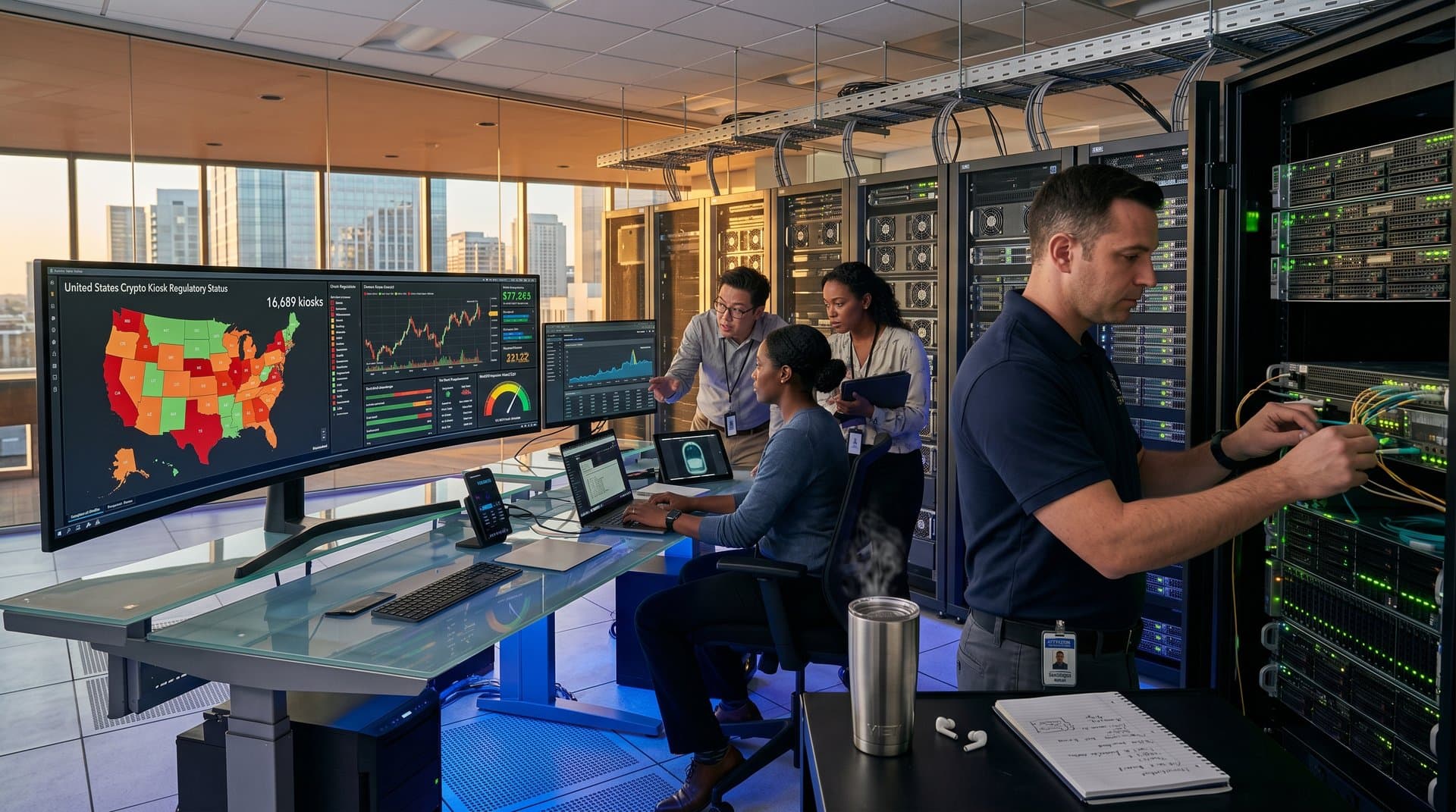
Crypto kiosk regulation classifies operators as money services businesses (MSBs) across 50 U.S. states, delaying expansions 6-12 months at $500,000+ cost, per Duane Morris Government Strategies. U.S. kiosks total 16,689 machines processing $2 billion annually (CoinATMRadar, October 2024). BTC trades at $77,245, up 0.3% (CoinGecko).
Fear & Greed Index sits at 26 (Alternative.me), signaling caution amid rising FinCEN MSB filings up 25% year-over-year.
- Asset: BTC · Price (USD): 77,245 · 24h Change: +0.3%
- Asset: ETH · Price (USD): 2,327.88 · 24h Change: +1.5%
- Asset: XRP · Price (USD): 1.39 · 24h Change: 0.0%
- Asset: BNB · Price (USD): 627.69 · 24h Change: +0.2%
FinCEN Federal Rules Set MSB Baseline for All Kiosks
FinCEN mandates MSB registration for crypto kiosks nationwide. Operators implement AML programs, report transactions over $2,000, and conduct KYC verification. Federal compliance averages $150,000 yearly for mid-sized firms, based on FinCEN MSB data.
Non-compliance risks $250,000 fines per violation. Duane Morris Government Strategies calls this the foundation before state requirements multiply complexity.
State Regulations Vary Widely, Driving 6-12 Month Delays
California requires reports on transactions over $1,000 plus $100,000 surety bonds (California Department of Financial Protection and Innovation). Texas demands $100,000 net worth minimums and prominent fee disclosures (Texas Department of Banking).
New York enforces BitLicense applications at $5,000 upfront fee plus ongoing audits (NYDFS). Florida mandates monthly reports to the Office of Financial Regulation. Wyoming streamlines with simple notice filings for crypto operations.
This patchwork adds $500,000 in legal, bonding, and licensing per new state, per Duane Morris analysis. Operators face $10,000 fines per violation.
Cloud Platforms Slash Compliance Costs by 70%
Cloud solutions like AWS RegTech and Azure Sentinel centralize KYC/AML via APIs. Real-time state rule tracking, geofencing blocks restricted kiosks, and unified dashboards handle 100+ machines.
Duane Morris reports 70% workload reduction through automated bonding and licensing. Low-latency OFAC SDN checks complete under 1 second. Bitcoin Depot partners with Duane Morris for scalable legal support.
Operators deploy analytics for optimal retail placements, boosting revenue 15-20% in compliant zones.
U.S. Kiosk Market Hits 16,689 Machines, $2B Volume
CoinATMRadar tracks 38,493 global kiosks, with U.S. share at 16,689 as of October 2024. Annual volume exceeds $2 billion, driven by retail BTC demand.
Hardware makers General Bytes and Lamassu integrate cloud layers for multi-state ops. High-traffic spots like convenience stores yield $50,000+ monthly per cluster.
Growth accelerates with BTC volatility; Q3 2024 deployments rose 12% quarter-over-quarter (CoinATMRadar).
FinCEN Filings Surge 25%, Competition Intensifies
FinCEN MSB registrations climbed 25% YoY, reflecting kiosk boom. Compliant firms like Bitcoin Depot capture market share via trust and efficiency.
Duane Morris forecasts cloud-enabled M&A for license grabs. Low Fear Index (26) prioritizes cost controls.
Strategic Implications for Kiosk Startups
Startups pivot to cloud for 70% savings, targeting Wyoming-like havens first. Multi-state mastery unlocks $2B volume.
Non-adopters risk fines and stalls; leaders consolidate via acquisitions. BTC at $77,245 fuels demand, but regs demand tech stacks.
Future Outlook: Consolidation and Cloud Dominance
Projections show U.S. kiosks reaching 25,000 by 2026 (CoinATMRadar estimates). Federal preemption talks could simplify, but states hold power.
Duane Morris advises hybrid legal-tech teams. Efficiency wins in Fear 26 markets.
Frequently Asked Questions
What is crypto kiosk regulation in the US?
Crypto kiosk regulation treats kiosks as money services businesses under FinCEN. States add licensing, bonding, and reporting rules. Duane Morris Government Strategies maps 50-state details.
How does crypto kiosk regulation vary by state?
California requires $1,000+ reports and bonds. Texas mandates fee displays. New York charges $5K for BitLicense. Wyoming uses simple notices, per Duane Morris.
What compliance strategies work for crypto kiosk startups?
Cloud platforms automate KYC/AML, geofencing, and licensing—cutting costs 70%. Partnerships with Duane Morris enable scaling across states.
How do crypto kiosk regulations affect industry expansion?
Regs delay rollouts 6-12 months but reward cloud adopters. U.S. kiosks at 16,689 process $2B+ amid BTC $77,245 demand.