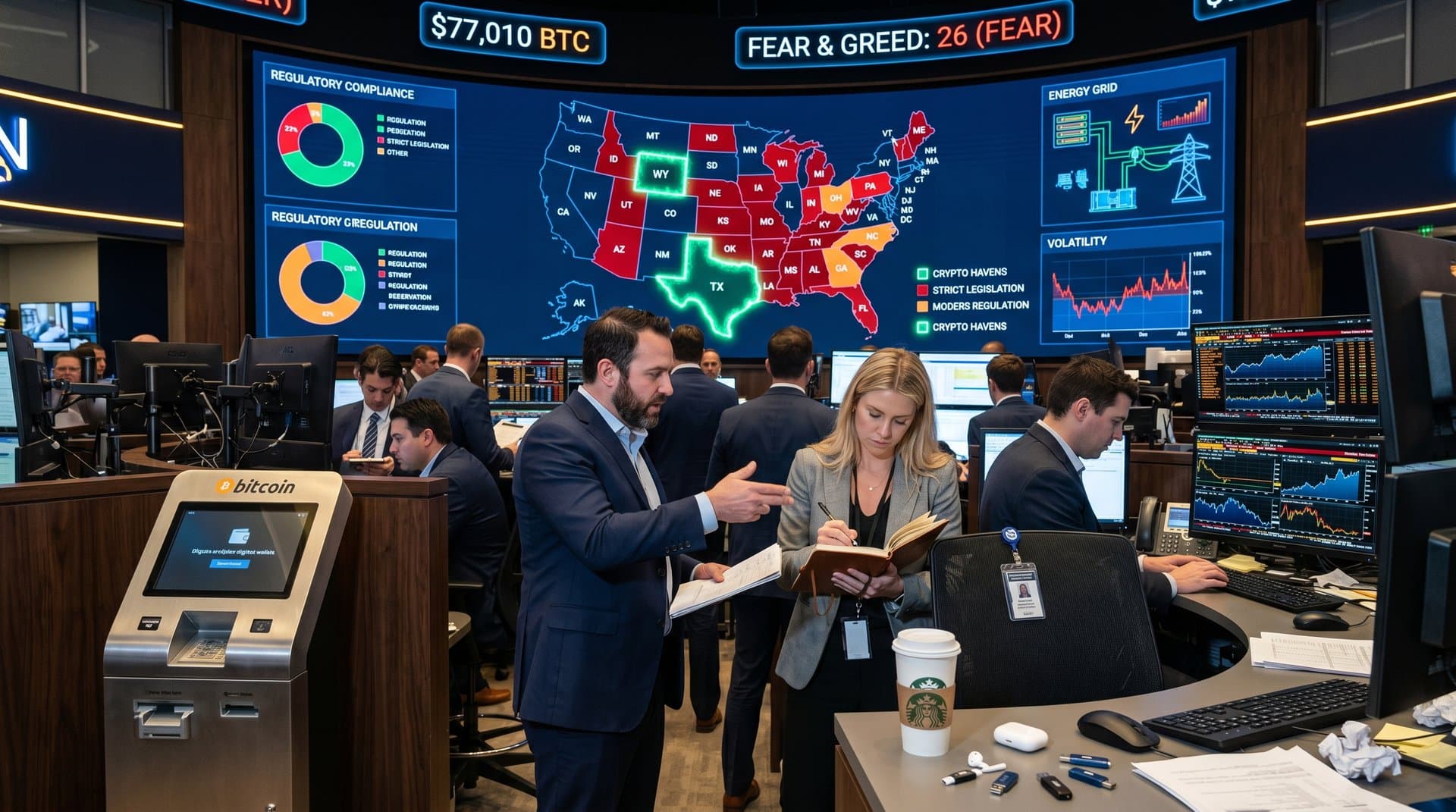
- 1. Wyoming issues licenses in weeks, enabling 50-unit fleets.
- 2. Startups hit 12% margins vs. giants' 4% in havens.
- 3. Fleets double by 2027 per Duane Morris forecasts.
Wyoming and Texas crypto kiosk regulation creates havens for startups. They deploy Bitcoin ATMs faster than giants amid $77,010 BTC (up 0.3%, CoinGecko). Fear & Greed Index stands at 26 (Alternative.me). Duane Morris Government Strategies outlines compliance edges.
Kiosks convert cash to crypto instantly. They earn 5-10% fees in high-traffic spots like convenience stores.
Wyoming Leads Crypto Kiosk Regulation
Wyoming's 2018 money transmitter laws grant licenses in weeks via Special Purpose Depository Institution Charter. Over 200 kiosks operate statewide (Wyoming Division of Banking, 2024). Duane Morris notes startups like Bitcoin Well link units to local mining ops.
Breakeven requires 20 transactions daily per kiosk. $5 average fees work at $77K BTC. Volumes grow 25% YoY (Chainalysis State of Crypto Report, 2024).
Texas Department of Banking streamlines Money Services Business registration. No BitLicense equivalent hinders giants. Oil field energy surplus powers mining hybrids for 99% uptime.
Strict States Slow Crypto Giants
New York's BitLicense demands $5M net worth and $500K annual audits. California requires agent-of-the-state compliance. High-reg states host 40% fewer kiosks (CoinDesk, March 2024).
Bitcoin Depot (NASDAQ: BTM, $250M market cap) averages 4% margins across 50 states. Startups target 5-10 havens for 12% net fees. They use remote KYC and Chainalysis AML tools.
- Asset: BTC · Price (USD): 77,010 · 24h Change: +0.3% · Market Cap: $1.52T
- Asset: ETH · Price (USD): 2,322 · 24h Change: +1.6% · Market Cap: $279B
- Asset: XRP · Price (USD): 1.39 · 24h Change: -0.2% · Market Cap: $79B
- Asset: BNB · Price (USD): 625 · 24h Change: +0.1% · Market Cap: $91B
CoinGecko data shows BTC resilience in fearful markets.
Permissive Regs Power Startup Financials
Fragmented crypto kiosk regulation triples compliance costs for multi-state operators (Duane Morris). Boutiques partner with 7-Eleven for pilots. They integrate Solana and Lightning Network ramps.
A 100-kiosk fleet generates $2.5M ARR at 5% fees and $50 daily volume per unit. Capex falls to $3K per kiosk with Chinese hardware. VCs value at 8x revenue, beating 6x public comps like BTM.
FinCEN mandates KYC scans. Mobile apps cut verification to 15 seconds. Yield-bearing USDC adds 4% APY (Circle, 2024). Unbanked users (15% of U.S. adults, FDIC 2023) surge during dips.
Market Fear Spikes Kiosk Demand
Fear & Greed at 26 drives 30% volume increases (Chainalysis). Kiosks enable cash buys up to $900 daily amid exchange hacks. AI AML detects 99% illicit flows pre-transaction.
Support spans 20 assets, including XRP post-Ripple wins. Retailers earn 1% rev-share. Scale targets 5,000 U.S. sites by 2026.
Back Haven Startups Before Federal Shift
VCs deployed $150M into kiosk startups last year (PitchBook, 2024), eyeing 40% CAGR. Wyoming's Crusoe Energy hits 25% IRR. Texas accesses $10B energy subsidies.
FIT21 Act preemption faces 2-3 year delay (Duane Morris). Target Series A rounds at $10-20M valuations for 10x returns as BTC nears $100K.
Crypto kiosk regulation builds lasting moats. Operators double fleets by 2027 (Duane Morris).
Frequently Asked Questions
What is crypto kiosk regulation in permissive U.S. states?
Wyoming and Texas require basic money transmitter licenses. Startups deploy fast without heavy audits. Duane Morris calls these innovation hubs.
How does crypto kiosk regulation affect Bitcoin ATM startups?
State regs create havens for nimble operators. They outpace giants by focusing on low-barrier states. Revenue thrives at $77K BTC.
Why do state regs favor startups over crypto giants?
Fragmented rules inflate costs for multi-state giants. Startups cherry-pick havens with quick licensing. Multi-chain tech boosts efficiency.
What role do kiosks play in fearful crypto markets?
Fear & Greed at 26 pushes cash to kiosks. They provide secure on-ramps amid exchange risks. Regs enforce AML compliance.