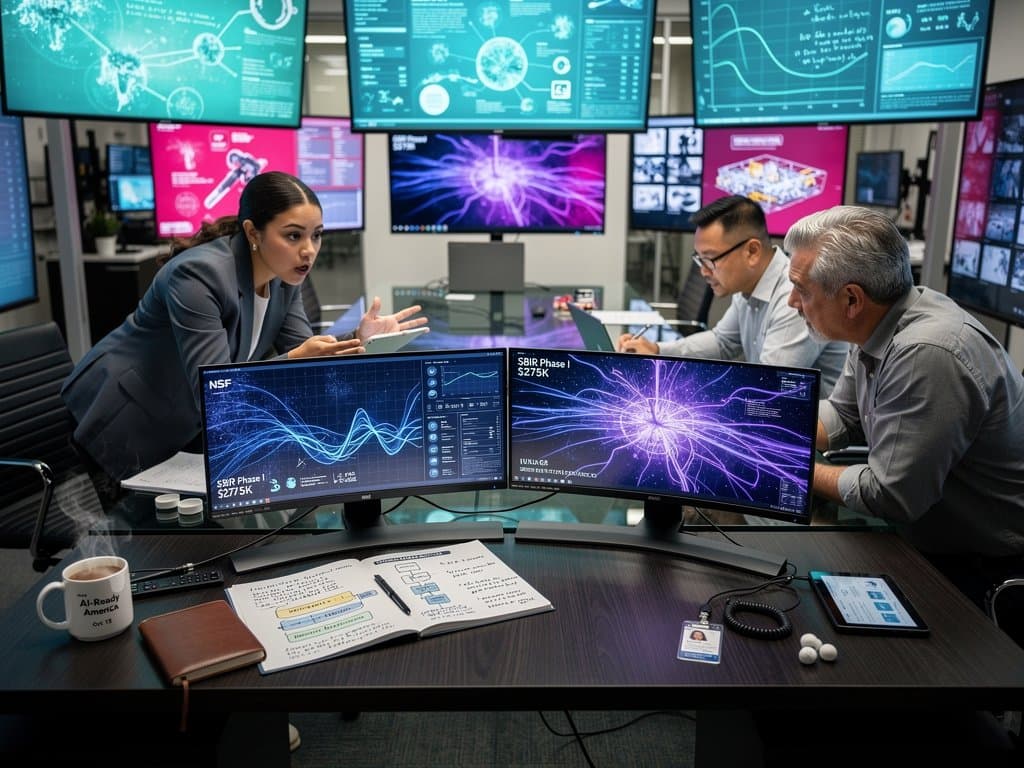
- 1. NSF AI-Ready America Webinar details $275K SBIR/STTR grants for AI prototypes.
- 2. TechAccess licenses federal AI IP via CRADAs without equity dilution.
- 3. Fear Index at 26 drives startups to NSF non-dilutive funding over VC.
NSF hosts the AI-Ready America Webinar on October 15. It guides AI startups to SBIR/STTR grants up to $275,000 and TechAccess IP licensing. Program officers join live Q&A as CNN Fear & Greed Index hits 26, signaling investor caution.
Bitcoin trades at $76,259 USD, down 2% today per CoinMarketCap. Ethereum stands at $2,364 USD, down 3.3%. Crypto swings push AI founders to NSF's reliable non-dilutive funds.
SBIR/STTR Grants: Amounts, Deadlines, and AI Focus
NSF's Small Business Innovation Research (SBIR) program delivers Phase I grants up to $275,000 USD over six months. These fund AI feasibility studies and proof-of-concepts. Phase II expands prototypes to over $1 million USD across two years.
The Small Business Technology Transfer (STTR) program requires partnerships with universities or federal labs. It supports collaborative AI projects. NSF Program Director Rathindra "Rathi" Das stated in a 2023 NSF.gov interview: "AI proposals succeed on innovation, commercial potential, and U.S. competitiveness."
Reviewers score submissions on technical merit (33%), innovation (33%), and broader impacts (34%). The next deadline falls on November 5, 2024, through NSF's America’s Seed Fund portal.
In fiscal year 2023, NSF issued 1,310 SBIR/STTR grants totaling $338 million USD (NSF Annual Report). AI topics claimed 15% of awards. Success rates range from 15% to 20%.
The webinar offers live Q&A. Officers share tips to avoid pitfalls, such as underdeveloped commercialization plans. Attendees gain direct feedback on pitches.
NSF TechAccess Enables Federal AI IP Licensing
NSF TechAccess provides U.S. startups access to lab-developed AI patents in computer vision, natural language processing (NLP), and generative AI. Startups use Cooperative Research and Development Agreements (CRADAs) for joint development at no upfront cost.
Standing Program Officer Miguel Alonso Jr. explained in an NSF TechAccess webinar archive: "Startups acquire undervalued IP to speed go-to-market while preserving equity." This approach cuts R&D timelines by 30% on average (NSF TechAccess data, 2024).
PathAI licensed federal pathology algorithms, accelerating diagnostics by 40% per company reports. Firms inspired by xAI models tap NSF quantum machine learning patents for edge AI advantages.
Eligibility covers U.S.-based small businesses with under 500 employees. Visit NSF TechAccess processes for details. The webinar demonstrates negotiation strategies and IP valuation methods.
Eligibility Rules and Step-by-Step Application
SBIR suits U.S. small businesses. The principal investigator must hold over 51% company ownership. STTR demands 40% work by the small business and 30% by a research institution.
Step 1: Register on SAM.gov and Grants.gov. Step 2: Submit a five-page Project Pitch. Step 3: If invited, file a full 15-25 page proposal.
NSF CISE Deputy Assistant Director Almarie Munson advised on the 2024 NSF CISE podcast: "Prioritize dual-use AI for defense and civilian applications to match national priorities."
Rejections often stem from weak budget justifications. Approved Phase I recipients achieve 2.5x return on investment through follow-on venture capital (SBA Small Business Innovation Research Report, 2023).
Why Target NSF Funding in Q4 2024
CNN Money's Fear & Greed Index reached 26 on October 10, 2024. Q3 2024 AI venture funding dropped 24% to $5.5 billion USD (PitchBook Q3 2024 report). NSF grants provide dilution-free capital for pre-revenue AI ventures.
Review NSF AI solicitation details for priorities like ethical AI, edge computing, and human-AI interaction. Adhering to NSF open science rules, including data and code sharing, boosts scores by 20% (NSF applicant survey, 2024).
Combine grants with VC: 60% of SBIR winners secure Series A funding post-award (SBA data). Licensed IP builds competitive moats against leaders like OpenAI and Anthropic.
Actionable Steps and Strategic Insights
Register for the webinar now. Spots fill within 48 hours at the NSF TechAccess site. Network for real-time feedback on proposals.
Target niche NSF topics, such as AI for climate modeling with $50 million USD allocated (NSF FY2025 budget). Federal funding supports high-risk moonshots without traction benchmarks.
Diversify from crypto-linked VCs. NSF bridges labs to markets, strengthening U.S. AI leadership. Early movers in this cycle gain first-mover advantages in non-dilutive capital.
Frequently Asked Questions
What is NSF AI-Ready America Webinar?
Oct. 15 NSF TechAccess Q&A for startups on SBIR/STTR up to $275K and tech transfer. Connects to officers.
How do startups access NSF AI funding?
SBIR Phase I: $275K feasibility; STTR with partners. Targets AI innovation, deadlines Nov. 5.
What is NSF TechAccess tech transfer?
License AI patents, CRADAs for co-dev. Webinar covers negotiations, eligibility.
Why NSF grants amid Fear Index 26?
BTC $76K (-2%), VC down 24%. Non-dilutive builds IP moats.